I didn’t come back to the Catholic Church all at once.
There wasn’t a single moment of clarity, no dramatic return, no lightning strike of conviction. It was slower than that. Quieter. More like a gradual shift under the surface until, one day, I realized I was already on my way back.
For a long time, I had moved in a different direction. Wicca drew me in with its sense of feminine spirituality. There was something deeply meaningful about that—something I hadn’t felt in Catholicism, at least not in a way I could recognize at the time. It felt expansive, intuitive, and in many ways, freeing.
And yet.
What I didn’t realize then was that part of me was still looking for structure, for rootedness, for something older than myself. But I couldn’t name that absence while I was in it. I only recognized it later.
The return didn’t begin with a decision. It began with a feeling.
The first time I went back to Mass on my own, without obligation or expectation, something in me settled. That’s the only word for it. Settled. There wasn’t a rush of emotion or a clear thought. Just a quiet, steady sense of yes. This is where you need to be.
What surprised me most was that I hadn’t even known I missed it.
I hadn’t been walking around consciously longing for the Church, or for the sacraments, or for the rhythm of the liturgical year. But sitting there, hearing the familiar prayers, moving through something that had shaped me long before I questioned it, I felt a kind of recognition that went deeper than thought.
And then there was a moment I can’t quite explain. The priest lifted the bread and the wine, and it was as if the room shifted. Not visibly, not dramatically—but unmistakably. You could almost feel it move through the congregation: a kind of collective awe, a quiet, steady love directed toward something just beyond reach and yet somehow present.
I hadn’t known I was missing that either.
It wasn’t about agreeing with everything. It still isn’t.
Part of my distance from the Church had been tied up in my identity as a feminist. That tension hasn’t disappeared. I wouldn’t say I resolved it so much as… learned to live inside it. There are still things that don’t sit easily with me. There are still questions I don’t have answers to.
But something shifted. I stopped needing the Church to be perfect in order to remain within it.
Around the same time, I began to understand my mother’s faith in a way I never had before.
When she was alive, her faith was quiet. Steady, but not something she talked about much. It wasn’t something she explained or tried to pass on in words. After she died, I found traces of it—notes in books, things she had written, small glimpses into a spiritual life that had been sustaining her all along.
There was something humbling about that. And grounding. Her faith hadn’t been loud or performative. It had simply been there, holding her.
I think, in some way, that mattered more than I realized at the time.
There are other, more practical threads woven into this story too. My husband works for the Church. His faith is strong in a way mine has never quite been—unwavering, steady, certain. I don’t always understand it. Sometimes I envy it.
And sometimes it’s more complicated than that—especially when that same commitment asks more of him than I sometimes wish it did.
Because faith, for me, isn’t just personal anymore. It’s something I carry into my family life, whether it fits neatly or not.
Even within our own immediate family, belief isn’t shared in a single direction. We come at faith from very different places, with different convictions, different doubts, and different ways of making sense of it all.
It’s not always comfortable. There are differences that don’t resolve neatly, conversations that require care, and moments where we feel the distance between us. Even something as simple as what to call the winter holidays can get complicated—Yule, Christmas, or just “December,” depending on who you’re talking to.
And yet, this is the space I live in—learning how to hold both love and disagreement at the same time.
So my return hasn’t been neat.
It hasn’t been a full-circle moment where everything suddenly makes sense. It’s been more like stepping back into something familiar with new eyes, noticing both what draws me in and what still unsettles me.
But I keep coming back.
Not because I have everything figured out. Not because all the tensions have been resolved. But because, somewhere beneath all of that, there is still that quiet sense of yes.
And, for now, that is enough.
Tag: love
-
Returning to Catholicism With New Eyes
-
What Catholic School Taught Me About Being a Girl—and a Woman
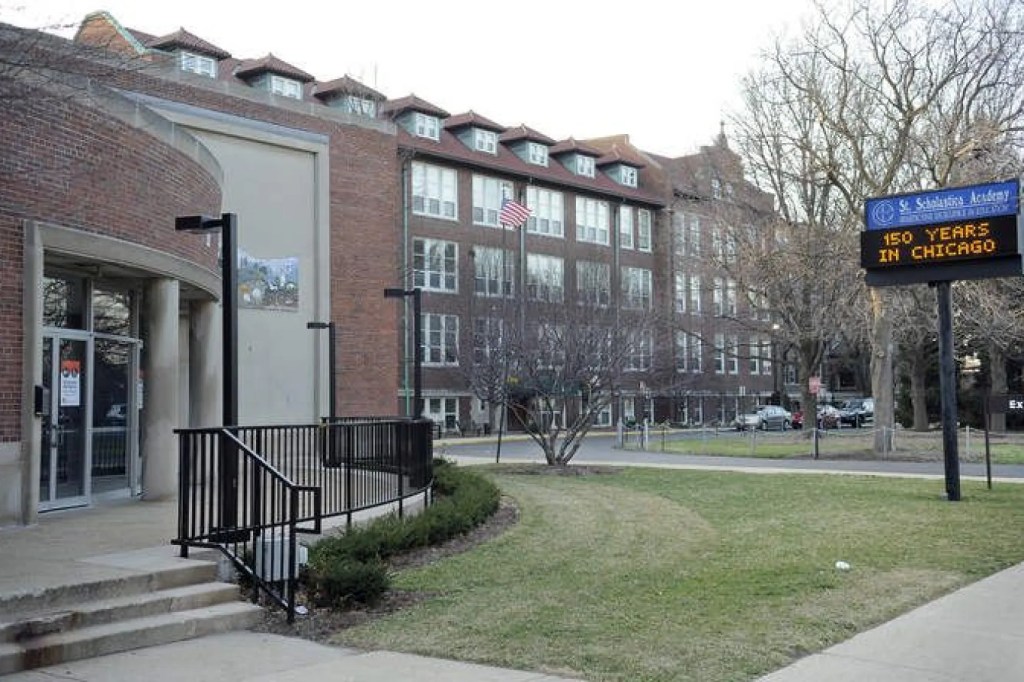
I spent years in Catholic schools, including an all-girls high school, learning what it meant to be a girl.
Looking back now, I realize I was also learning—quietly, and often without knowing it—what it might mean to become a woman.
One of the things that stands out most is something I didn’t question at the time.
There was no stigma attached to speaking up.
We were expected to have thoughts. To share them. To engage.
And in that environment, something subtle but important happened—we learned that our voices mattered.
A Different Kind of Space
Without the usual social competition that can come with co-ed spaces, relationships felt… different.
Stronger, in some ways.
Not perfect—there were still mean girls, of course. But more often than not, that came down to ordinary pettiness, not the kind of constant comparison that can shape how girls see themselves.
There was space to simply be—to think, to learn, to grow.And it wasn’t just the teachers who shaped that experience.
Some of the women I went to school with are still part of my life today.
We’ve stayed in touch over the years, and in different ways, they continue to inspire me, challenge me, and remind me of the kind of women we were being encouraged to become—even back then.
There’s something meaningful about relationships that grow over time.
Not perfect. Not constant. But steady.
And I’m grateful for that.

