Tag: Germany

  • The House Where We Could Exhale

    The House Where We Could Exhale

    There are seasons of life when you never quite unpack completely.

    Even if the boxes are empty, part of you stays ready for the next change. You hesitate before putting too many holes in the wall. You postpone projects for “someday.” You tell yourself you’ll wait until the next place before buying the furniture you really want or planting roots that might have to be pulled up again.

    You live there.

    But you don’t quite expect to stay.

    When our family first arrived in Germany as missionaries, that made perfect sense.

    The first house we lived in was the mission house, generously provided through the support of others. Everyone knew it was temporary. It was a gift, and we were grateful for it, but no one expected it to be home forever.

    Our second house was only around the corner. The church owned it, and we lived upstairs while the ground floor, originally intended to become a twenty-four-hour prayer room, instead became home to refugee families. It was there that neighborhood life began to take shape. The children downstairs adored the rabbits in the garden, even if they occasionally fed them things rabbits probably shouldn’t have eaten.

    It was a good place.

    But it still felt like part of a chapter that was being written one page at a time.

    Then we moved again.

    Not across the country.

    Not even across town.

    Just about a mile away.

    This time, though, something was different.

    The difference wasn’t the neighborhood. Much of our life remained exactly where it had been. Church was the same. Work was the same. Friends were the same.

    The difference was quieter than that.

    For the first time since arriving in Germany, we stepped into a house that wasn’t simply where we happened to be living.

    It was where we began imagining a future.

    Of course, life didn’t suddenly become perfect.

    There were still responsibilities, disappointments, ordinary family disagreements, and all the small frustrations that come with everyday life. Refuge doesn’t erase those things.

    Life became ordinary.

    There were grocery trips and dinners around the table. School days. Church. Work. Weekends that arrived without carrying the weight of another transition. Our youngest daughter found her place at the after-school youth center, building friendships that became part of the rhythm of her life. One of my neighbors was also someone I worked with. The different parts of our lives no longer felt separate. They overlapped in the easy way they do when you’ve lived somewhere long enough for your world to knit itself together.

    There wasn’t one grand moment when I announced to myself, We’re home now.

    There was only the quiet accumulation of ordinary days.

    Then, somewhere along the way, I realized something had changed.

    Almost without noticing, we had stopped living as though we might have to leave.

    For the first time in Germany, we were choosing to build our future there.

    Looking back, I think that’s what transformed that house into a refuge.

    It wasn’t the size of the rooms or the neighborhood or even the fact that it belonged to us.

    It was the quiet confidence that tomorrow would begin in the same place as today.

    It was the freedom to make plans without wondering whether another move lay just around the corner.

    I used to think a refuge was a place where nothing difficult ever happened.

    Now I think it’s something quieter than that.

    A refuge is the place that gives you permission to stop living as though everything is temporary.

    The place where, almost before you realize it, you finally exhale.

  • The World Cup That Spoke Both Languages

    The World Cup That Spoke Both Languages

    Some evenings stay with you long after you’ve forgotten the score.
    For me, it’s the 2014 World Cup final.
    The match kicked off just after evening Mass.
    We lived only a short walk from the church, so instead of everyone heading home, they came to our house. Father knew exactly what day it was. He picked up the pace just a little because kickoff was coming, and he was invited too.
    By the time we reached the house, every chair was spoken for.
    Family. Friends from church. A couple of Americans visiting Germany. Father found a seat. Everyone else settled wherever they could—on the couch, on the floor, leaning against a doorway. Even my daughter, still a preteen and the youngest person there, slipped naturally into the circle. She wasn’t treated like one of the kids. She was simply part of the group.
    German snacks filled the table alongside bowls of chips, beer, and soft drinks.
    Our television wasn’t nearly big enough, so we improvised.
    A computer. A projector. A blank brick wall.
    It wasn’t fancy.
    It didn’t matter.
    For ninety minutes, that wall became the center of our little world.
    Long before I lived in Germany, the World Cup had already become part of my life. My dad sort of followed the World Cup – part of being a soccer grandparent. During those summers, he knew he could call me at almost any point and I’d have the standings memorized, the latest results ready, and the next fixtures already circled in my mind.
    Football was one of the languages my family shared.
    By 2014, I had been living in Germany long enough that another football language had quietly become my own. Weekend by weekend, I’d watched Bundesliga matches with my husband, always hoping his beloved Eintracht Frankfurt would be the one on television. Somewhere along the way, Germany had stopped feeling like someone else’s team.
    Then came extra time.
    The cross.
    The touch.
    The volley.
    Mario Götze scored.
    The room exploded.
    My husband had been sitting backward on a chair, his arms folded across the backrest. He roared, threw both fists into the air—and tipped the chair over behind him.
    Nobody cared.
    We were all shouting.
    Laughing.
    Hugging.
    I’m convinced the whole neighborhood was making exactly the same noise.
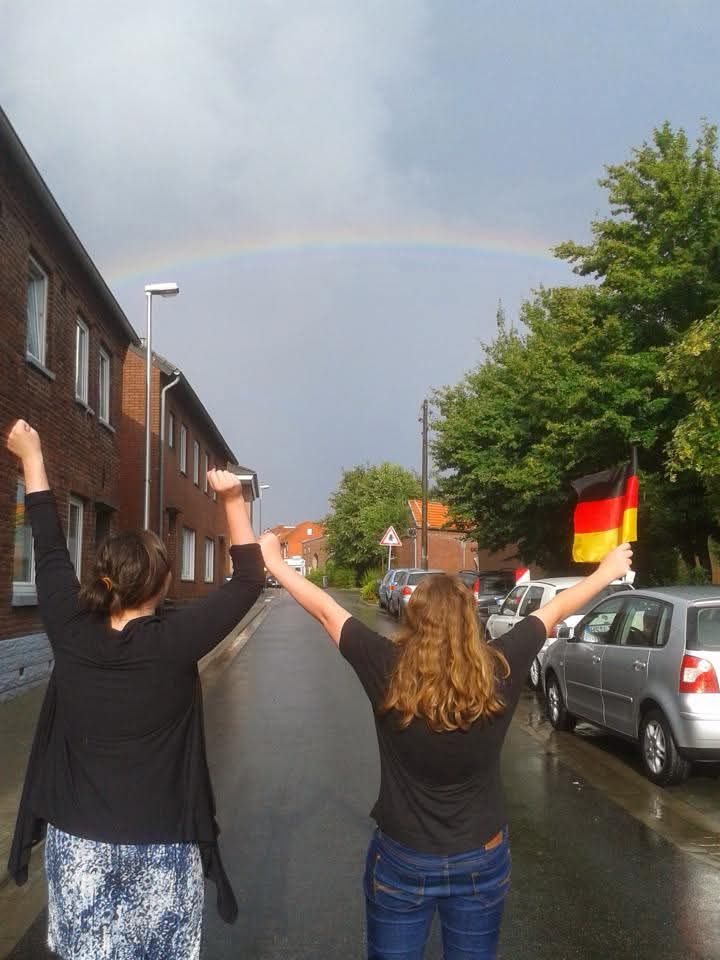
    When we finally wandered outside, we took the German flag from our front window. My daughter and one of the American visitors wrapped themselves in it and walked into the middle of the street.
    Faces painted.
    German shirts.
    Neighbors celebrating.
    For a little while, our quiet village sounded like one enormous living room.
    Looking back now, I don’t remember every pass from that final.
    I don’t remember every save.
    I remember a priest hurrying through Mass because he knew where everyone wanted to be afterward.
    A blank brick wall transformed into a stadium.
    A living room so full that people sat wherever they could.
    My husband cheering so hard he knocked over his chair.
    My daughter standing in the middle of a German street wrapped in a German flag.
    Germany lifted the World Cup that night.
    But when I think about that evening now, it isn’t the trophy I remember.
    It’s the sound.
    One room.
    One village.
    One joyful roar.
    For ninety unforgettable minutes, it didn’t matter where any of us had been born.
    We all spoke exactly the same language.