How does a child inherit a way of seeing the world?
Most of us would probably say our first classroom was an elementary school. We remember tiny desks, sharpened pencils, and the teacher who taught us to read.
But I’ve come to believe our first classroom begins much earlier than that.
Long before anyone teaches us the alphabet, someone is quietly teaching us what matters. Children don’t just inherit eye color or family recipes. They inherit habits of attention. They learn what is worth noticing, what is worth caring about, and whether the world is something to be explored or simply endured.
Looking back, my first classroom was a third-floor apartment in Chicago.
It wasn’t a remarkable place by most standards. Money was often tight. My mother was a teacher and a working single parent at a time when that wasn’t yet common. She worried about bills more than she let me see, and when life became overwhelming, she could lose her temper in spectacular fashion. Neither of us has ever handled stress particularly gracefully.
But those aren’t the things I remember first.
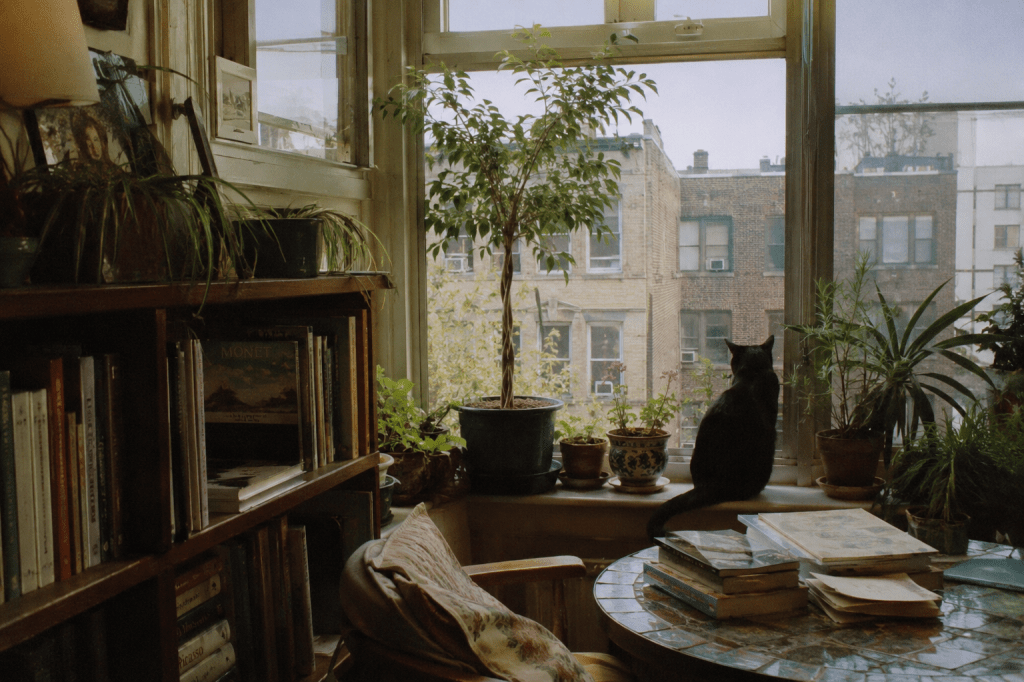
I remember books and music. I remember a sunroom filled with plants that somehow flourished under my mother’s care, though I’ve never inherited her talent for keeping anything green alive. I remember a cat waiting at the door when I came home from school.
I lived in that apartment for thirteen years. It wasn’t large, and it certainly wasn’t fancy, but it was home. It was safe. Somehow it held bookshelves and records, musical instruments and houseplants, a kitchen table where homework happened, and enough room for curiosity to take root.
I was a latchkey kid, so I usually came home before my mother did. The cat greeted me at the door, and more often than not, I’d end up curled up in the sunroom with a book while I waited for her.
No one told me to do that. It was simply the kind of home we lived in.
I barely remember the television, but I remember pages turning, records playing, library books coming and going. I remember my mother reading on the train as she commuted to and from school.
She never announced that books were important. She simply lived as though they were.
The same was true of museums.
One of our favorite places was the Art Institute of Chicago, especially the Thorne Rooms. Every visit became a game. The museum would occasionally change one tiny detail—a painting, a piece of furniture, some almost invisible object—and we searched every room with eagle eyes until one of us spotted it.
“There!”
“I found it!”
Looking back, I realize we weren’t really searching for what had changed.
We were learning to notice.
My mother loved Monet. She loved museums, music festivals, books, new ideas, and the excitement of a student finally understanding something that had once seemed impossible. She volunteered at the Chicago Historical Society, where she demonstrated life in the pioneer era. I can still picture her patiently spinning flax into thread on a spinning wheel, making it look effortless while I wondered how anyone could have such steady hands.
She also believed that if you cared about the world, you should do something about it. Election seasons meant volunteering, handing out leaflets, registering voters, and encouraging people to participate. For my mother, being interested in the world meant taking part in it.
Without ever saying the words, she cultivated wonder.
And she never stopped being curious herself.
Years later, when my mother visited us in Europe, she wanted to know everything about wherever she happened to be—what something was, why it was there, how it worked, what had happened there before. Ten million questions, give or take.
If anyone asked why she wanted to know all those details, her answer was simple: “I don’t know. I just want to know what’s going on around me—all the details of where I am.”
That was my mother. She wanted to know where she was in the world.
It wasn’t until I was an adult that I realized not every home cultivates that kind of curiosity.
As I met people whose lives had been shaped by different experiences, I began to understand that curiosity isn’t inevitable. It isn’t simply a personality trait reserved for a fortunate few. Like kindness, generosity, or hospitality, it can be quietly cultivated—or quietly neglected.
That’s when I began to understand what my mother had given me.
She hadn’t simply taught me to love books or museums or music. She had taught me to remain interested—to ask another question, to look a little longer, to believe there was always something more to discover.
Years later, I caught myself reading aloud to my own children, wandering through museums with them, answering one more question, encouraging one more curiosity. I wasn’t consciously copying my mother. I was simply living the way she had taught me to live.
Only then did I realize I was passing along an inheritance I hadn’t even known I’d received.
Maybe that’s how a child inherits a way of seeing the world.
Not through speeches or perfectly planned lessons, but through the ordinary rhythms of a home where books are read, music is played, questions are welcomed, beauty is noticed, and curiosity quietly becomes part of everyday life.
It makes me wonder about all of us.
What are we making ordinary?
Because children don’t just inherit what we teach.
They inherit what we make room for.

