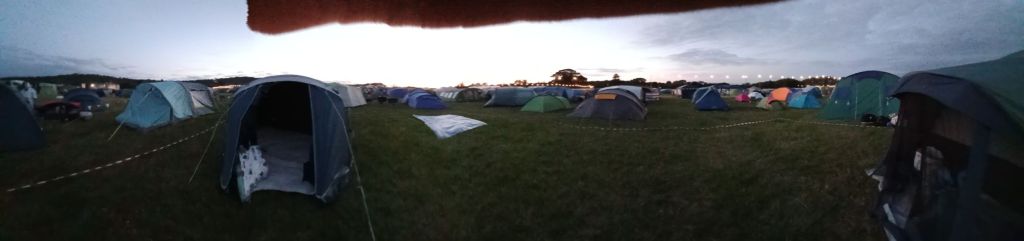
We arrived at Big Church Festival on Thursday after having been on the road since eleven the night before, which meant our first spiritual exercise of the weekend was trying to put up a new-to-us tent before it rained.
We weren’t alone.
All around us, people were doing the same thing—setting up camp, exchanging smiles, lending a hand when someone needed one, watching the sky. Eventually tents were standing, more or less as their manufacturers intended, and people began drifting toward the campsite gathering area with its market and food stalls.
It was familiar.
We’ve been going to Big Church, on and off, for about twelve years. I’ve gone through quite a few spiritual twists and turns during that time, but I keep coming back.
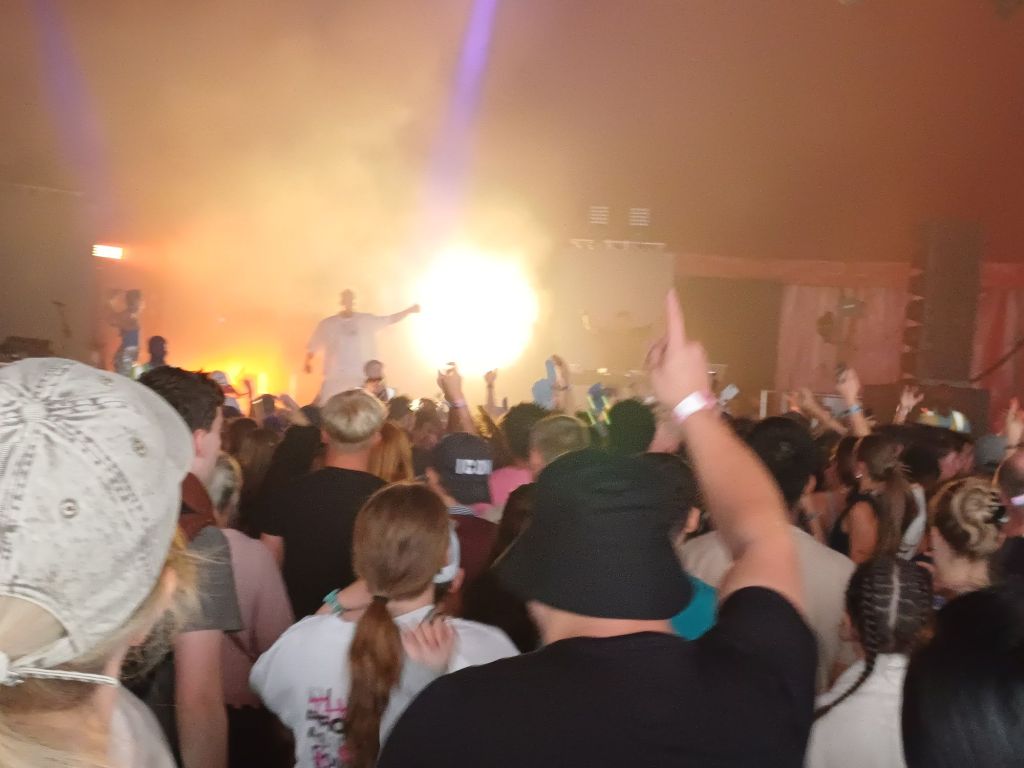
Part of it is the music. There are artists I genuinely love and look forward to seeing, including the band LZ7. Their music has always brought an energy and joy to the festival that feels especially meaningful in a place built around shared faith and community. I had been looking forward to seeing them again this year.
Part of it is the almost complete lack of internet access, which in most circumstances is a feature rather than a bug.
Mostly, though, there is a certain peace there. Thousands of people gather because of something they share, and for a few days there is a sense of people uniting around something good.
Friday morning began the way Big Church mornings usually do.
Coffee first.
Then figuring out who we absolutely wanted to see, checking in with people arriving later, gathering the stroller and blanket and everything else required when a toddler is part of your festival equipment.
We went down to one of the gates around 9:30 and, while we waited, made friends with the volunteers and the people around us. Once the gates opened, we found our spot and settled in for the day: talking, listening to music, chasing a sometimes-crabby toddler.
Our usual.
Later, I heard an artist I hadn’t heard before, Franni Cash. I loved her voice and her openness, and discovering she was a fellow Southerner certainly didn’t hurt. During one of those rare moments when my phone found enough internet to remember what the internet was, I followed her on Spotify.
Her song “Holy Water” absolutely rocked.
My daughter and granddaughter were wandering around the festival grounds while I held our spot.
The wind had been picking up. I was keeping half an eye on the clouds. A few raindrops fell.
Then Franni began another song.
An official came onto the stage and stopped her almost as soon as she started.
She looked confused.
So did we.
There had been an incident, we were told. Everyone needed to leave the festival area. Campers should return to the campground. Day visitors needed to exit.
And just like that, the music stopped.
Thousands of us began moving toward the exits in a controlled mass. Almost immediately, rumors started.
Something had happened.
Someone had been hurt.
Maybe several people.
I didn’t know where my daughter and granddaughter were.
I tried to reach them. So did seemingly everyone around me, all of us holding phones that weren’t particularly useful even on a normal festival day. With very little information and a great deal of uncertainty, my mind went to some frightening places. I wondered whether there had been some kind of attack.
On the way back to camp, my husband found me.
Our daughter and granddaughter were already there.
Safe.
Eventually, nearly everyone seemed to end up around the campground gathering area. Rumors continued to circulate while we waited for actual information.
The big screen announced that the evening’s events had been cancelled.run it
That hurt in a surprisingly ordinary way. There were artists I had really been looking forward to seeing, including LZ7 and Rendering Collective. It felt strange to be grieving something so much larger while also feeling disappointed that the music we had traveled so far to hear was suddenly gone.
We still didn’t understand what had happened.
Then volunteer teams began walking through the campground.
The entire festival was cancelled.
We could stay that night, but everyone had to be gone by noon the next day.
By then, the rumors were becoming more specific. A large sign had fallen. People had been seriously injured. There might have been a fatality.
Eventually, we learned there had been.
A man had died.
Across from us, a church group began to sing.
They weren’t the only ones. In different parts of the campground, people began gathering for their own impromptu praise and worship.
At the time, it felt almost defiant to me.
Fine.
If we can’t do this where we’d planned to do it, we’ll do it here.
There were no stages now. No headliners. No carefully planned festival schedule.
There were just people singing in a campground after something terrible had happened.
It felt like spitting defiance into the darkness.
Later, we learned that the church group across from us was the church that had lost its pastor.
Their pastor had died.
That knowledge changed the way I understood what I had witnessed.
Their young people were there. Their youth group had just experienced something almost impossible to comprehend, and somehow the people around them had found something familiar to hold onto. Something they could do together when there was very little anyone could actually do.
They sang.
That night, the campground was filled with praise and worship music and a strange, pervasive numbness.
Both things were true at once.
There was faith.
And there was grief.
The faith did not cancel the grief.
It did not answer the question that has followed me ever since: Why?
Why there?
Why him?
Why can something awful simply crash into the middle of something good?
I don’t have an answer.
Perhaps more importantly, I’m not sure I need to manufacture one.
My own faith is changing again. These days I am much less certain about institutions and much more certain that there must be something beyond the life we see and live every day. I don’t have particularly good words for it yet.
Maybe I don’t need them.
Because on Friday, when I was separated from my family, I prayed.
When I didn’t know what had happened, I prayed that it wasn’t something terrible.
When we learned people had been hurt, I prayed for them.
And when people began raising their voices around that campground, I found myself grateful that they could still sing.
Perhaps that is part of what faith is for.
Not explaining the terrible things.
Not pretending they aren’t terrible.
Not providing a tidy answer to why bad things happen in places filled with good people.
Perhaps faith is what gives us enough hope and purpose to keep choosing good anyway. It can unite us. It can move us toward one another. It can remind us that the worst thing happening in a particular moment is not necessarily the only thing happening.
The next morning, we packed the tent we’d only just put up.
Our ferry wasn’t booked until Tuesday. We had plans to stay at Hever Castle on Monday, but suddenly there were several unplanned days in between. I frantically found somewhere for us to stay midway between Steyning and Hever.
Then we left.
That first day away, we mostly cocooned.
I knew I needed time and space and peace to understand what had happened.
I wasn’t ready yet.
I’m not sure I completely am now.
But when I think back to that Friday, the thing I remember most clearly isn’t the evacuation.
It isn’t the rumors.
It isn’t desperately trying to reach my daughter.
It isn’t even the moment we were told that Big Church Festival—the weekend we’d traveled all that way for—was over almost before it had begun.
I hear the singing.
I also remember the music that never got played: the artists we had been waiting to see, the songs we had expected to carry us through the evening, and the particular joy LZ7 would have brought to that stage. That absence has become part of the memory too—not because it matters more than what happened, but because it reminds me how abruptly an ordinary, joyful weekend can change.
We will go back next year.
There isn’t much question about that.
Partly because we love Big Church.
Partly, if I’m being completely truthful, because this year’s festival was one spectacular washout and I still want my weekend.
But we’ll also go back out of solidarity.
I imagine walking onto those grounds again will carry an enormous mixture of grief and resolve. The place will be different because something terrible happened there. We will remember those who died and were injured. We will remember the people whose lives had changed forever while we packed up our tents and went home.
But I suspect the music next year will feel deeper because of it.
Maybe louder.
Certainly more precious.
I hope some of the same artists can make it back. I hope I get to hear them play in the place where, this year, the music stopped. I hope the sound of the festival returning doesn’t erase what happened, but carries it with care.
Because something good happened at Big Church too.
When the official music stopped, people kept singing.
When there were no answers, people gathered together.
When there was grief, there was still hope.
And when darkness arrived in a place I had always associated with peace, I watched people refuse to let darkness have the only voice.
(News account https://www.bbc.co.uk/news/articles/clyk7rz1pllo)